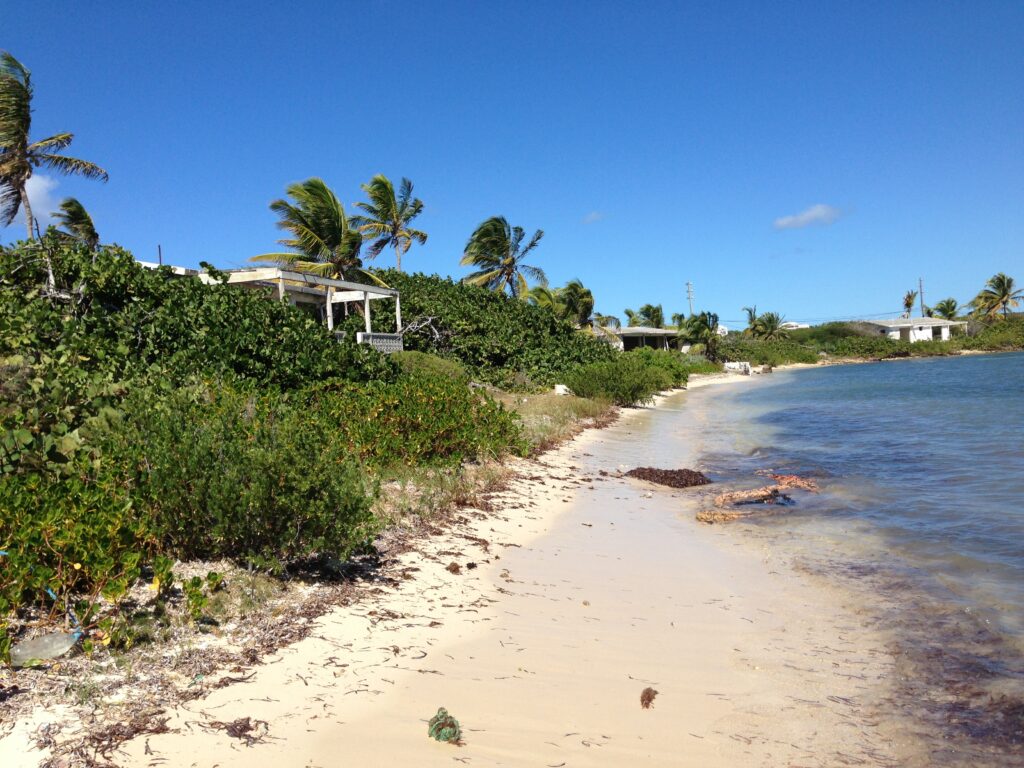
In 1984, I was sent to Anguilla to renovate a derelict hotel.
I was 27-years old. My boss handed me an envelope containing $1,400 cash, a check for $5,000, a single page brochure for something called Corito Cottages, and a plane ticket to a Caribbean island I had never heard of.
I had forty-five days to reopen eleven buildings that had been closed for seven years.
Anyone who has managed construction projects already understands what forty-five days means when you are starting from zero.
When I arrived, I found concrete walls eaten through by salt air. Corroded rebar. Failed plumbing. An electrical system that needed complete rewiring. Bougainvillea grown into dense thorned walls. Sand drifted into every corner. Goats wandering freely through abandoned guest cottages.
There was no supply chain to rely on. No overnight delivery. No ordering materials online. Everything had to be found, shipped, improvised, or carried onto an island thirty-five miles square with limited fresh water and no deep-water harbor.
And the deadline was not moving.
This was 1984. There was no scheduling software. No project management platform. No digital tools to track progress, flag risks, or coordinate across teams. There was a legal pad, a pencil, and fifty men who showed up every morning.
I hired fifty workers, most from the East End of the island, and named a man named Euton Smith — everyone called him Smitty — as crew chief.
That turned out to be the most important decision I made.
Not because Smitty was the best builder, though he probably was. But because Smitty understood something I was only beginning to learn.
We were not simply rebuilding a property.
We were building trust.
On Anguilla, nothing meaningful happens without relationship. You can arrive with money, schedules, blueprints, and urgency. But if the community does not believe in what you are doing, eventually none of it matters.
Nobody explained that to me formally.
I learned it slowly, by watching.
At lunch we sat together in whatever shade we could find. Rice and beans. Curry goat. Fresh fish when someone had it. Stories moved easily — about storms, family, people who had left the island, and people who had returned.
Slowly, without ever announcing it directly, the island began deciding whether to trust me.
The work got done.
Forty-five days. Eleven buildings. The reopening test was a Rotary Club dinner for 150 people — prime rib with Idaho baked potatoes, sourced through St. Maarten because that was what the job required.
Against all odds, it worked.
Years later, after decades in construction and nuclear risk advisory work, I came to understand what had really happened during those forty-five days.
The technical risks were obvious: corrosion, structural deterioration, supply-chain failures, compressed timelines. All of them assessable, manageable, documentable.
The human risks were harder to quantify.
And they mattered far more.
Would the community trust an outsider enough to work alongside him? Would the island accept someone who arrived with cash and a renovation plan but no history there?
Those were the risks that determined whether the project succeeded or failed.
No spreadsheet could measure them.
I have spent thirty years since then advising on construction and nuclear projects — some of them among the largest and most complex ever attempted. Budget overruns in the billions. Schedule failures measured in years. In almost every case, the technical risks were identified, assessed, and managed. The human risks — trust between stakeholders, confidence between owner and contractor, community acceptance — were the ones that proved hardest to control. And the ones that, when they failed, brought everything else down with them.
I got lucky.
I had Smitty. I had fifty men who decided to give me a chance. And I had an island that watched carefully before slowly deciding I belonged there.
What happened during those forty-five days shaped everything that followed — thirty years of construction and nuclear risk advisory work, and eventually a book about the island that taught me what risk assessment never could.
Showing up is not enough.
You have to show up the right way.
And then you have to keep showing up.