
There are places on earth where the sky tells you something it won’t say anywhere else.
Anguilla is one of them.
The island sits at roughly 18 degrees north latitude — close enough to the equator that on certain nights, at certain times of year, something rare becomes visible to anyone standing on its southern shore and looking up.
To the north, low on the horizon: Polaris. The North Star. Fixed. Unwavering. The star that has guided navigators home across the northern hemisphere for thousands of years.
To the south, also low on the horizon: Crux. The Southern Cross. The star pattern that guided navigators across the southern hemisphere for just as long.
Both visible simultaneously. Both telling you where you are. North and south, held in the same sky above the same island.
I have seen it many times. Standing on the southern shore at Corito. Later at Seafeathers Bay, looking south past Rainbow Reef toward the open Caribbean. Early morning, before the sky began to lighten. The North Star to my left. The Southern Cross to my right.
Two celestial navigation systems. One island. One sky.
I was always struck by it. But it wasn’t until I understood what lay beneath my feet that I understood why it mattered.
Roughly fifteen hundred years before I stood on that shore, the Taíno people stood on the same ground and looked up at the same sky.
They were navigators. They crossed open water in large carved canoes — piraguas — moving between islands using the stars as their guide. The North Star told them how far north they were. The Southern Cross oriented them to the south. Between those two fixed points, they moved through the Caribbean with a precision that European sailors would not achieve for centuries.
And they chose Anguilla.
Not as a place to pass through. As a destination.
Archaeological excavations at the Fountain Cavern — a sacred limestone cave near Shoal Bay on Anguilla’s northeastern coast — have recovered ceremonial pottery from multiple islands, including St. Martin and parts of the Greater Antilles. Chemical analysis confirms that people crossed open water by canoe to reach this specific cave on this specific island. The Fountain was not a local shrine. It was a regional pilgrimage site.
What drew them here?
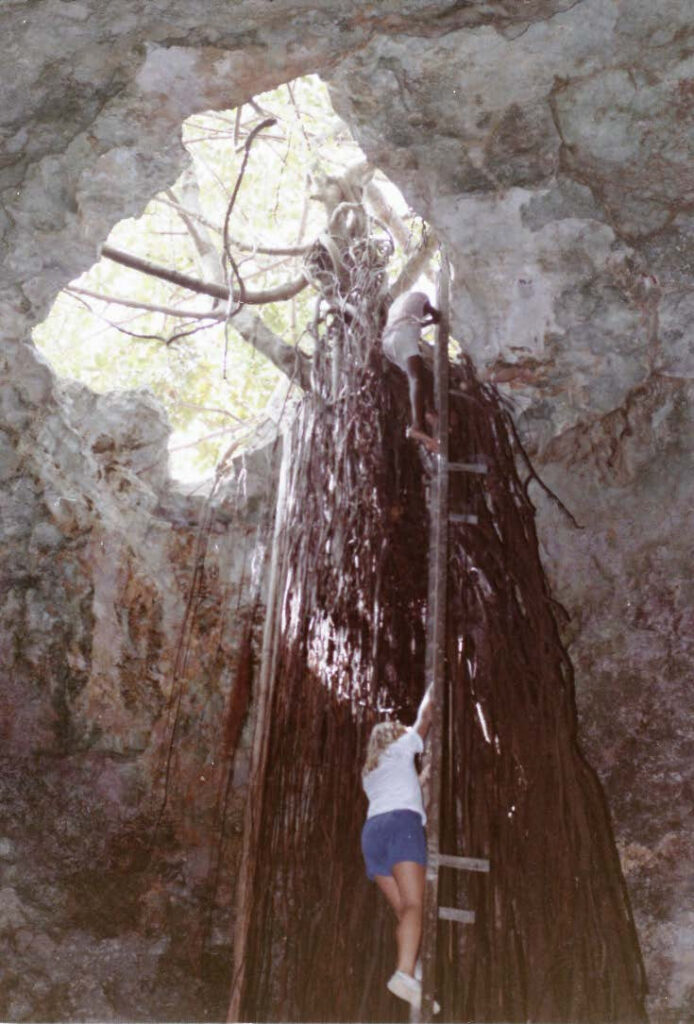
The cave descends approximately 65 feet into the limestone. At the bottom: a freshwater pool. In a region prone to drought, a permanent underground water source was precious beyond measure. But the Taíno understood it as something more than water.
In Taíno cosmology, the cosmos was divided into three spheres. The cave was the birthplace of humanity — the place where humans first emerged into the world. The underground pool was where the ancestors’ spirits lived. And looking up through the natural skylight in the cave ceiling, one could see the sky — the dwelling place of the gods.
All three worlds. Present simultaneously. In one place.
The Fountain Cavern contains at least 33 preserved petroglyphs — the most intact collection in the Lesser Antilles. At its center stands a 14-foot natural stalagmite that Amerindian artists carved to represent Yúcahu — Jocahu — the supreme Creator God of the Taíno, Lord of Cassava and the Sea, the most powerful deity in the Taíno cosmos.
At certain times of year, a shaft of sunlight penetrates the cave entrance and falls directly on the carving.
The supreme god illuminated by the sun. Underground. Fifteen hundred years ago. On the same island where, on certain nights, you can stand on the southern shore and see both the North Star and the Southern Cross in the same sky.
The British Government nominated Fountain Cavern for UNESCO World Heritage status. Archaeologists have described it as one of the most significant Amerindian ceremonial sites in the entire Caribbean — there are no comparable sites known in the eastern Caribbean and fewer than a handful in the Greater Antilles.
It is locked behind a steel grate.
Guarded by wasps.
With an 80-foot ladder required to reach the pool below.
The Anguillian government has been working for years to find a way to open it safely. The challenge is not indifference. It is the nature of the place itself — a sacred cave that has been protecting its own secrets for fifteen centuries, apparently content to continue doing so on its own terms.
The Taíno navigated to this island by the stars I watched for forty years from its southern shore. They came to stand in a cave where all three worlds converged. They carved the face of their supreme god into a stalagmite that the sun still finds, once a year, without fail.
The colonial record declared them extinct.
The cave still has 33 faces watching from its walls.
The pool still holds water.
The sun still finds Jocahu.
And on certain nights — early spring, before the sky lightens — if you stand on Anguilla’s southern shore and look north, then south, you can still see what the Taíno navigators saw.
Two skies.
One island.
The center of the world they knew.