
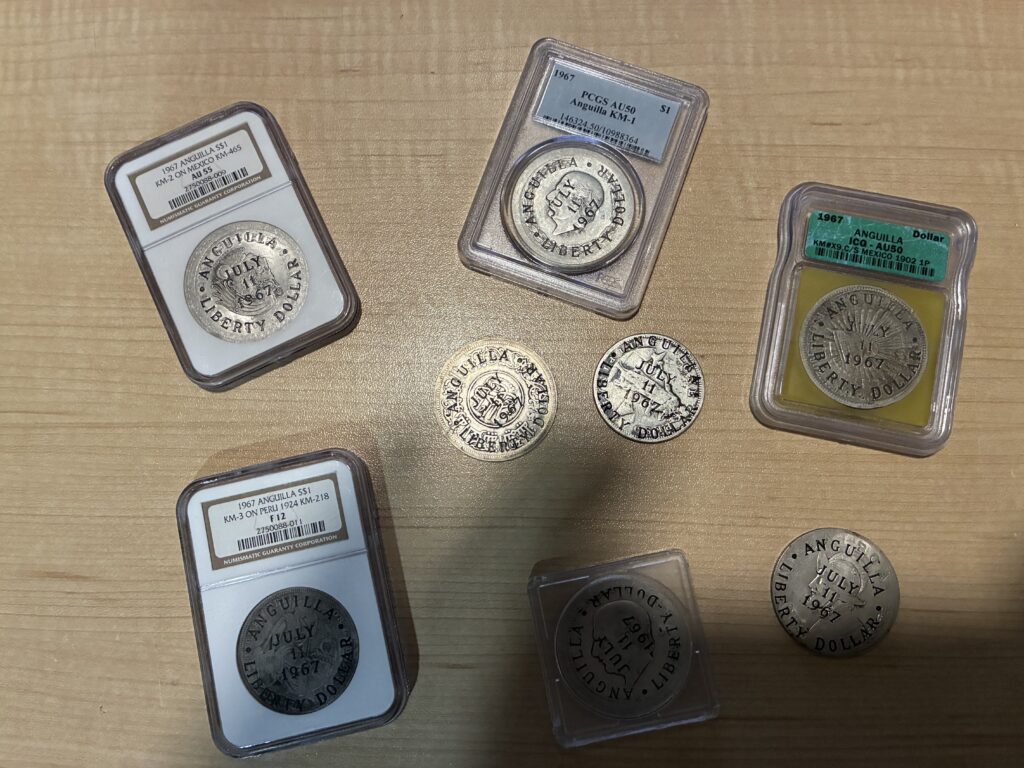
In 1967, Anguilla had declared independence but had almost no money.
The British would not recognize the new government.
The Americans would not either.
Yet somehow, the revolution would mint its own currency.
What Anguilla had was a referendum result of 1,813 to 5, an unshakable conviction that dignity mattered more than imperial convenience, and a group of well-meaning Americans from San Francisco with an unusual idea.
Why not mint coins?
Not from scratch—Anguilla had no mint, no dies, and no infrastructure for producing currency. What it did have was a hand press, a countermark, and access to silver coins from around the world.
The plan was elegantly improvised.
Existing silver coins—Mexican pesos, Peruvian soles, Yemeni rials, Philippine pesos, Panamanian balboas, Ecuadorian sucres, Chinese yuan, and others—would be counterstamped with a simple mark identifying them as Anguilla Liberty Dollars.
Each coin bore the legend:
Anguilla Liberty Dollar — July 11, 1967
The date of the referendum.
The coins would be sold to supporters for $10 each, redeemable for $10 U.S. Buyers would also receive an honorary Anguillian passport—valid for entering Anguilla as a guest, though probably unwise to use for international travel.
The treasury needed the money.
The world needed to understand Anguilla was serious.
The coins would accomplish both.
The Tilley Manufacturing Company in San Carlos, California—twenty-seven miles south of San Francisco—produced the counterstamps. The Island Council approved the arrangement. And in the fall of 1967, the Anguilla Liberty Dollars began circulating.
Supporters could purchase the coins through a full-page advertisement in The New York Times, turning silver into both fundraising and political theater.
In total, just over 10,000 coins were produced.
But not all varieties were created equal.
The most common—the Mexican 5-Peso Hidalgo—had a mintage of 5,987. Of those, roughly 4,000 were confiscated by St. Kitts authorities and melted down, leaving fewer than 2,000 believed to survive today.
From there, the numbers fall quickly.
Peruvian soles — 1,531.
Yemeni rials — 494.
Philippine pesos — 350.
Ecuadorian 5 sucres — 21.
Mexican 1 pesos — 15.
Chinese Yuan Shi Kai dollars — 10.
Among the thousands of counterstamped coins was a single British Trade Dollar—a detail so perfect that it sounds invented.
And then there is the rarest of all.
The Great Britain Trade Dollar.
Mintage: one.
A British silver coin—currency of the empire that had neglected Anguilla for centuries, bundled it into political unions it never chose, and would send paratroopers to restore order eighteen months later—counterstamped with the mark of the revolution.
One coin.
One act of perfect irony pressed into silver.
Today, the Anguilla Liberty Dollars are among the most historically significant coins ever produced in the Caribbean—tangible artifacts of a revolution that should have been impossible, minted by a government the world refused to recognize, and sold to supporters who believed six thousand people deserved the right to determine their own future.
Silver Magazine wrote about them in 1975. Numismatists have been searching for complete sets ever since.
Today, these coins remain tangible proof that revolutions are not always financed by governments, armies, or banks. Sometimes they are financed by conviction, a hand press, and a few ounces of silver.
The revolution funded itself with silver.