
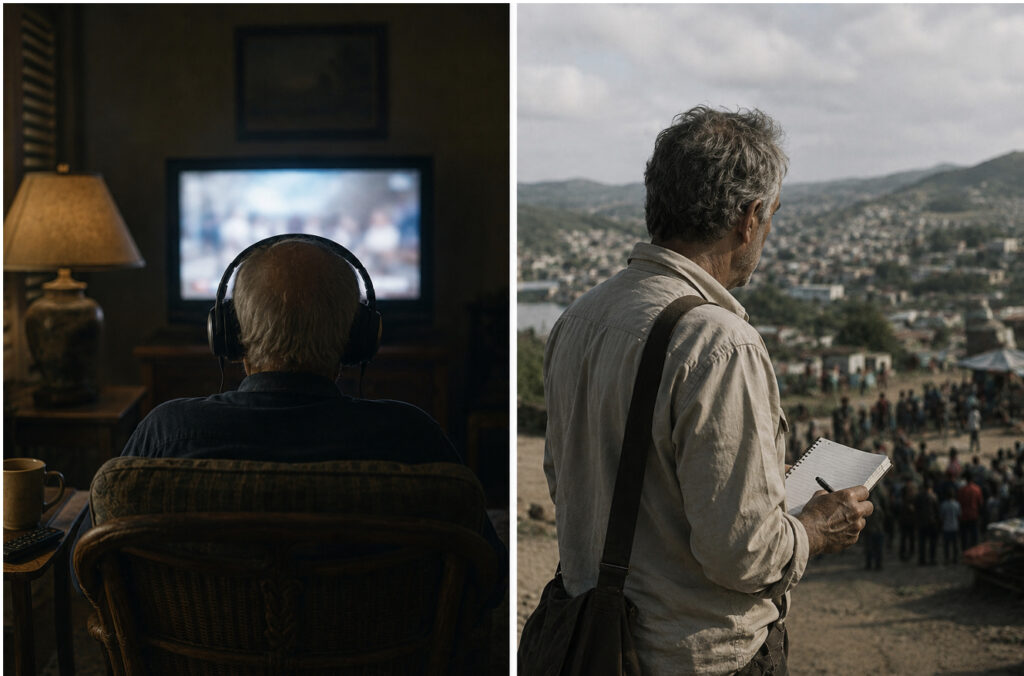
When I arrived on Anguilla in 1984, I met a man who would remain my friend until he died more than three decades later.
Over the years, I watched his world gradually become smaller. Illness took its toll. Melanoma left its mark. His hearing deteriorated. Friends passed away. Travel became less frequent. The circle of people he encountered regularly narrowed year by year until his universe was bounded largely by the walls of his living room.
What remained was the television.
Whenever I visited, it was on. As his hearing worsened, he began to sit directly in front of the screen wearing special headphones. The television was no longer merely a source of information. It had become companionship. It filled the silence. It connected him to a world he could no longer easily enter.
At first, I noticed little. Then I began to observe a subtle shift.
The language he used changed. His assumptions changed. His certainty increased. Gradually, his understanding of events, history, and people began to mirror the voices coming through his headphones.
This is not a story about one network or one political ideology. The names are unimportant. What I witnessed in that living room was something much larger. I was watching the relationship between a human being and information change in real time.
What made this especially striking was that it was happening on a tiny island that had no cable television until the mid-1980s.
When I first arrived there in 1984, information still moved largely through human relationships. People talked. They argued. They debated. News traveled through conversations on roadsides, in shops, at church gatherings, and around dinner tables.
People disagreed, sometimes passionately. But they shared the same physical reality. The person you criticized in the morning might be sitting next to you in church on Sunday. The neighbor whose politics annoyed you might help repair your roof after a storm.
Relationships imposed limits on division. Human beings remained more important than narratives.
Yet over time, even there, a television screen increasingly became a primary source of reality. I did not fully appreciate the significance of that change at the time. I do now.
For most of human history, reality was local. People learned what was happening from family, neighbors, churches, workplaces, and communities. Rumors existed. Bias existed. Falsehoods existed. But information was constrained by relationships. The person making a claim usually knew the people affected by it.
Reality possessed a built-in corrective mechanism: human contact.
Then came radio. Then television. Then cable. Then the internet. Then social media. And finally, algorithms that learned our preferences and fed them back to us in an endless cycle of reinforcement.
At every stage, we gained access to more information. At the same time, we moved farther away from direct experience. Increasingly, our understanding of the world came not from what we observed but from what we consumed.
The greatest challenge facing modern democracies may not be political polarization itself. Democracies have always contained disagreement. The deeper challenge is the erosion of shared reality. A free society requires citizens to debate what should be done. It cannot function if citizens can no longer agree on what has happened.
For much of the twentieth century, there existed an imperfect but vital bridge between local experience and national events. That bridge was journalism.
Most Americans would never personally witness wars, revolutions, economic crises, or events unfolding on distant continents. They depended upon journalists to serve as their eyes and ears. But the profession was organized around a powerful aspiration: verify first, report carefully, and separate fact from opinion whenever possible.
Certain figures came to embody that ideal. Their authority did not come from charisma or volume. It came from restraint. They understood that the story was not about them. Their role was to act as witnesses.
When people like Walter Cronkite reported an event, Americans might disagree about its meaning, but most accepted that the event itself had occurred. They served as common witnesses for a nation too large to witness events for itself.
I am fortunate to know one of those witnesses personally.
He spent his career reporting from places most Americans would never see. He covered wars, political upheavals, and some of the defining moments of the twentieth century, including the Anguilla revolution.
What has always struck me is his discipline.
The best journalists of his generation understood a distinction that now feels endangered. Their responsibility was not to become the story. Their responsibility was to witness it. The goal was neither applause nor outrage. The goal was credibility.
The purpose was to earn enough trust that when they told the public what they had seen, citizens could begin their debates from a common set of facts. That trust was never perfect. It was sometimes misplaced. It was occasionally betrayed. But it was real. And democracies depend upon it.
Today, as familiar journalistic institutions struggle and some of the last nationally recognized news voices leave the stage, I find myself wondering whether we fully appreciate what is disappearing.
We are not merely losing individual reporters. We are losing common witnesses—people whose professional obligation was to stand between events and public opinion long enough to establish what actually happened.
Information now arrives from thousands of fragmented sources competing for attention. The incentives reward speed, outrage, certainty, and emotional engagement. The old boundaries between reporting, commentary, advocacy, and entertainment have blurred.
As a result, we are losing something more significant than familiar names or recognizable faces. We are losing the very idea that a society might share a common set of facts.
Perhaps that is why I find myself thinking about my friend. His story was never really about television. It was about trust. Like all of us, he relied upon others to help him understand a world far larger than the one he could personally experience.
Now, I find myself thinking about two friends.
One sat alone in a chair, headphones pressed against failing ears, trying to understand a world he could no longer fully enter. The other spent a lifetime traveling the world so he could tell the rest of us what he had seen.
Between them lies the difference between seeing and being told.
One depended upon witnesses. The other depended upon voices.
What we are losing is not simply trust in institutions.
It’s more than that.
We are losing our common witnesses.