
Even back in 1976, when we celebrated our Bicentennial — and I was a nineteen-year-old Navy Honor Man — I never called myself a patriot.
Not because I lack love for my country. But because I grew up believing the label “patriot” is something history bestows, not something people declare about themselves. And when I think back on the people I admired most, I can’t remember any of them describing themselves that way.
I grew up in the 1960s, the son of a Korean War veteran and VFW Post Commander. I spent countless hours in VFW halls alongside men who had served in two World Wars — men who had marched, bled, and buried friends. They gathered on folding chairs in rooms that smelled of cigarettes and coffee, and they talked about the men they had lost and the places they had been.
Not one of them ever called himself a patriot.
They didn’t need to. Everyone in the room already knew.
As a boy, I marched in Memorial Day parades alongside those patriots — men in their sixties and seventies who had survived things they rarely spoke about. We marched through Stoughton, my hometown, to honor them. I didn’t fully understand then what I was witnessing.
I understand it now.
That was my education. Vietnam was on television every night. The Cold War shaped everything. Civil rights marches filled the streets. The space race captured our imagination. And through all of it, the men around me — the ones who had actually done something — said the least about it.
The ones who earn the label rarely claim it.
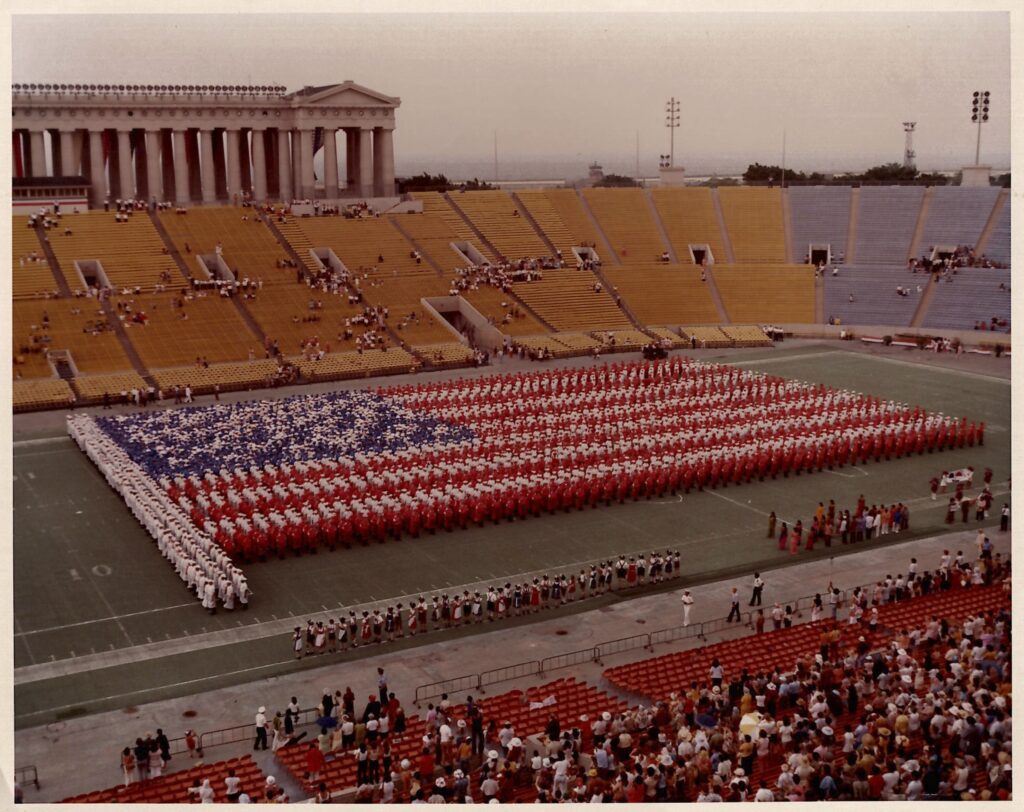
In 1976, during the Bicentennial, I stood on Soldier Field as part of what was then the largest human American flag ever assembled — active-duty sailors, soldiers, and airmen arranged shoulder to shoulder across the field.
At the time, I was simply one person standing in formation. Third white stripe from the top next to the blue.
Looking back now, I understand it differently.
Not as spectacle. As participation.
As belonging to something larger than yourself without needing to announce it.
I first arrived on Anguilla in October 1984. What I found there confirmed everything those men in the VFW halls had taught me without knowing it.
Anguillians didn’t talk much about loving their island. They demonstrated it in the only way that counts — by refusing to leave it in someone else’s hands.
For generations, the British Empire treated Anguilla as an afterthought. Too small to matter. Too remote to command attention. Infrastructure promised and never delivered. Funds allocated and never arrived. A pier built on St. Kitts and named after Anguilla — pointed toward the island the funds had been intended for.
They understood neglect intimately.
And yet.
When the moment came — when the choice was submission or resistance — six thousand people with no army, no navy, no international recognition, and almost no money chose resistance.
Not with speeches. Not with slogans. With fishing boats, borrowed courage, and the stubbornness of people who had been told for centuries that they didn’t matter.
They expelled the St. Kitts police force. They held a referendum. They waited for Britain to respond.
Britain sent paratroopers.
The island met them with cold drinks and candy bars.
That’s patriotism.
Not the performance of it. Not the announcement of it. The living of it — quietly, stubbornly, over generations, without needing anyone outside to validate it.
In recent years I’ve watched patriotism become something people proclaim rather than demonstrate. A label applied loudly, often in direct proportion to how little has actually been sacrificed for the places people claim to love.
An island taught me something different.
Patriotism and belonging aren’t declared. They are earned — through showing up, through sacrifice, through the willingness to stand your ground when standing costs something real.
Ronald Webster never called himself a patriot.
He just led.
Four days after Memorial Day this year, Anguilla celebrates May 30th — the day in 1967 when its people expelled the St. Kitts police force and began the revolution that would define their identity. They call it Anguilla Day. Not Independence Day — because independence hasn’t come yet. Just the day they stood up. The day they decided who they were.
Two very different places. Two different kinds of courage.
The same truth underneath.
The men in those VFW halls never called themselves patriots either.
History already knew.
That’s the kind that counts.