
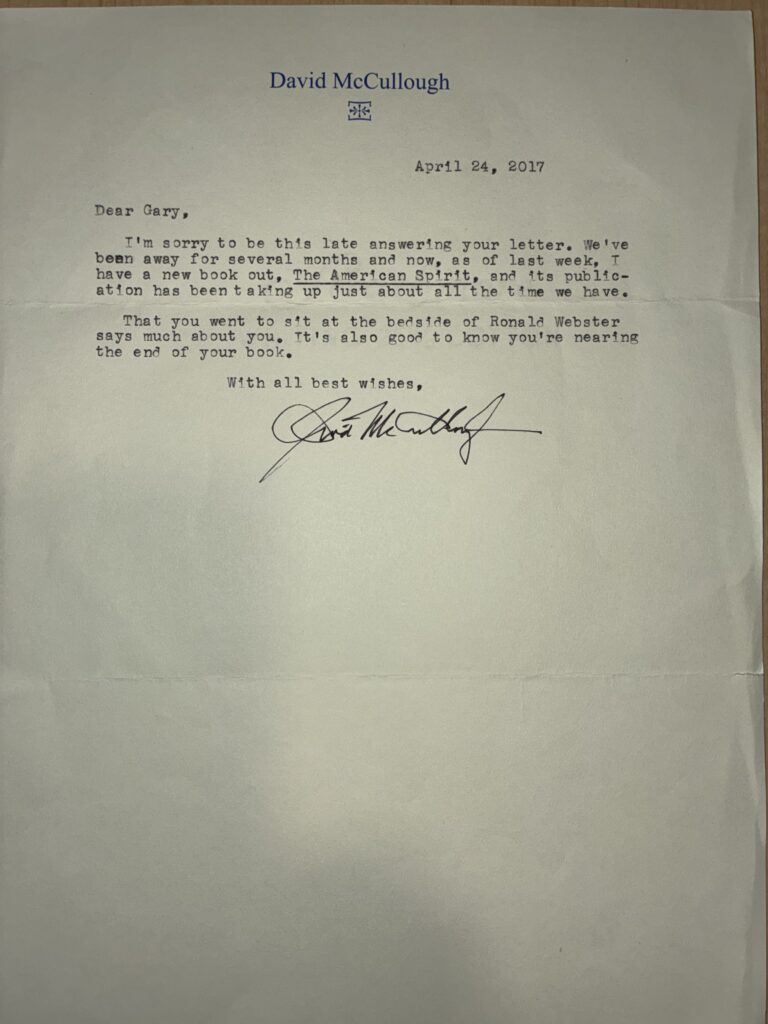
In 2014, something so profound happened to me that I had nowhere to go but to write David McCullough.
So I did.
He answered.
I want to tell you why — because it has almost nothing to do with what most people think gets a letter answered.
It wasn’t my credentials. I wasn’t a historian or an academic. I was an insurance executive from Massachusetts who had spent thirty years traveling to a small Caribbean island most people had never heard of.
It wasn’t my connections. I didn’t know anyone in McCullough’s world. I had no introduction, no mutual friend, no back channel. Just a letter and a stamp.
It wasn’t even the quality of the writing, though I worked hard on it.
It was the weight of what I was carrying.
In May 2014, Ronald Webster — the Father of the Nation of Anguilla, the man who led the island’s 1967 revolution against the British Empire — sat across from me in his sunlit office and handed me nineteen handwritten pages. He was eighty-eight years old and dying.
“I need you to do something for me when I’m gone,” he said.
He asked me to help ensure that Anguilla’s story would be told. That the promise Britain had made to his island in 1967 — full independence, whenever they were ready to ask — would not be forgotten.
He chose me. Not a historian. Not a journalist. An American businessman who had simply shown up, kept coming back, and said yes when asked.
I left that office carrying something I did not yet fully understand.
And I had nowhere to go but to write David McCullough.
Here is what I eventually came to understand about why he answered.
The letter was true.
Not impressive. Not strategic. Not carefully engineered to appeal to his interests or demonstrate my worthiness. It was simply true. I told him what had happened. I told him why it mattered. I told him I needed guidance. I asked if we could meet.
There was no performance in it. No positioning. No attempt to make myself seem more important than I was.
Just the truth of what had been placed in my hands, and the honest acknowledgment that I did not yet know how to carry it.
McCullough spent his life pursuing stories that mattered — stories about ordinary people who did extraordinary things, stories overlooked or forgotten by the official record.
Anguilla was all of those things.
And my letter, whatever its imperfections, conveyed that clearly.
He responded while in the final throes of writing The Wright Brothers. He invited me to visit him in Boston. We sat together in his Back Bay study for more than an hour. At one point, he told me to find Morton Dean — the CBS correspondent who had covered the British invasion of Anguilla in 1969. He said it the way someone says something when they already know the ending.
Before I left, he gave me one final piece of advice.
Write the book you would want to read yourself.
I never forgot it.
Over the years, I’ve come to believe that the letters that truly get answered are rarely the most polished ones. They are the ones that carry genuine weight. The ones written because something real has happened, and because the writer cannot remain silent about it.
Before writing to someone you admire, ask yourself honestly: Am I writing because I have something true to say? Or because I want something from them?
David McCullough understood the difference almost immediately.
So does almost everyone worth reaching.
Write the true letter.
People who matter usually know the difference.